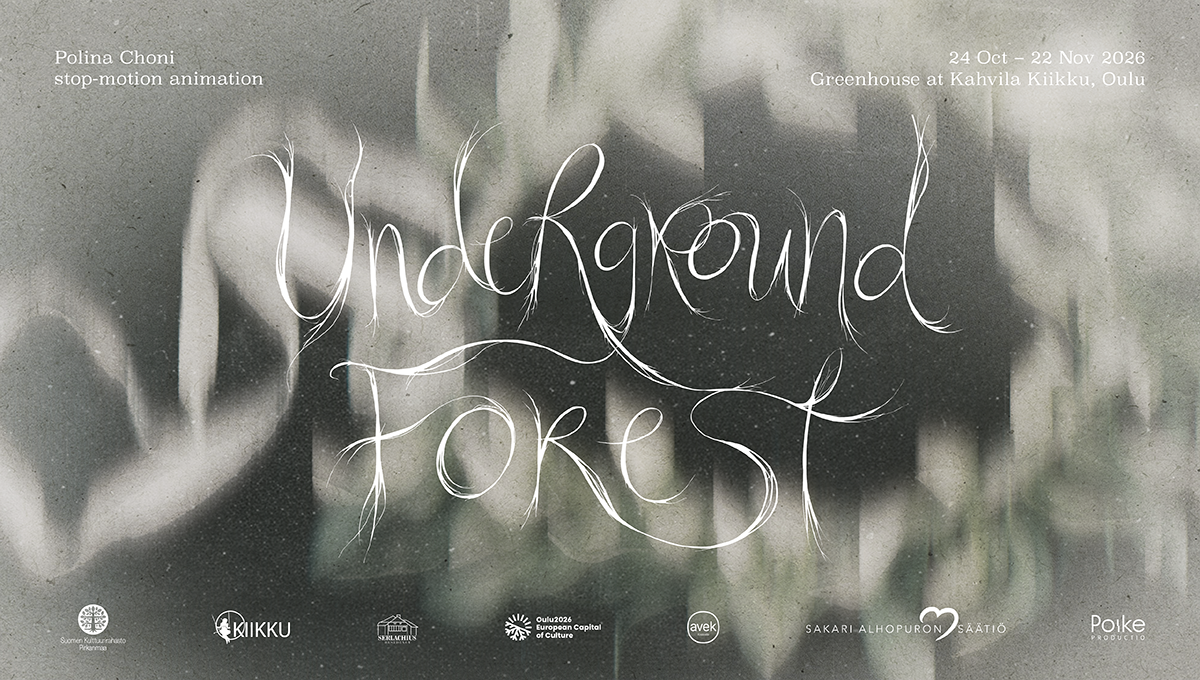
Ukrainian artist Polina Choni presents Underground Forest, a short stop-motion animation, at Kahvila Kiikku, Oulu.
Underground Forest
Kahvila Kiikku, Oulu, Finland
24.10.–22.11.2026
Polina Choni’s Underground Forest reveals the hidden life beneath the Ukrainian steppe.
Ukrainian artist Polina Choni presents Underground Forest, a short stop-motion animation developed from her field research in the Ukrainian steppe, particularly an expedition to the Tarutyno Steppe in the Odessa region. The work is presented at Kahvila Kiikku in Oulu as part of the Oulu2026 European Capital of Culture Programme.
The starting point for Underground Forest is the idea of the steppe as a kind of underground or inverted forest: what is visible above ground may be only a small and temporary part of a much larger ecosystem. Beneath the surface are roots, bulbs, rhizomes and dense networks whose scale and duration are not immediately clear from the landscape itself.
Underground Forest grew from plants Choni encountered and photographed during field research. Six species form an underlying herbarium for the work: Ornithogalum oreoides, Crambe tataria, Stipa lessingiana, Glycyrrhiza glabra, Isatis tinctoria and Eryngium campestre. Choni translates her observations into a material stop-motion language using wax, pale sand, natural pigments and fragments of pastel-coloured smalt found during the expedition.
A central distinction in the work is the difference between natural transformation and external disturbance. Drying, shedding seeds or disappearing below ground can belong to the seasonal life of a plant. Mechanical intervention follows another logic: it can rupture structures and relationships that have developed over time. For Choni, this is connected to the vulnerability of steppe ecosystems to ploughing, landscape transformation, afforestation of steppe territories and the effects of war.
The question is not only what survives, but whether the relationships that made the landscape possible still exist.
The greenhouse setting at Kahvila Kiikku becomes an integral part of Underground Forest. Within the glasshouse — a space where plant life is maintained through cultivation and care — the work introduces another kind of plant system: the steppe. Set into the ground, the screen shifts attention away from the plant as an isolated object and towards the surface itself, and what may exist beneath it.
The exhibition opens at Kahvila Kiikku in Oulu on Saturday, 24 October 2026 at 12.00. Opening speech by Laura Suurhasko: “The role of art and artistic thinking in ecological reconstruction and in imagining different relationships between humans and the environments they inhabit”.
The exhibition will be on view until 22 November 2026 and is open on weekends during Kahvila Kiikku’s opening hours.
The Underground Forest is supported by Oulu Culture Foundation, Kahvila Kiikku, Finnish Cultural Foundation / Pirkanmaa Fund, Sakari Alhopuro Foundation, Serlachius Residency, as well as Poike Productio and AVEK Mediarata.
Read more about Underground Forest animation »
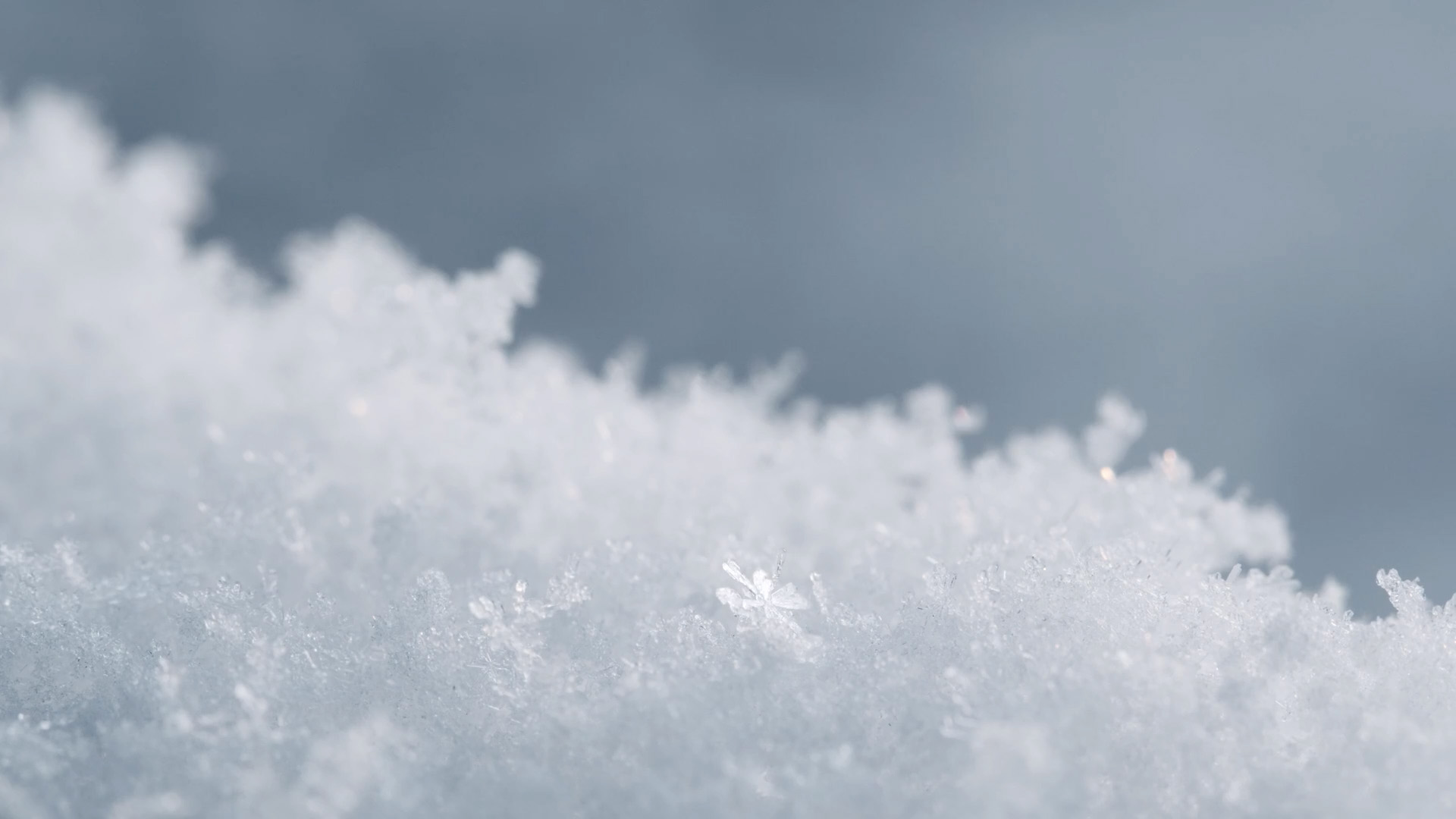
Farewell to Snow – Snowline, directed by Sanni Priha. Photo: Sanni Priha.
Farewell to Snow – Snowline
Chappe Art House, Ekenäs, Finland
02.10.2026–28.02.2027
In her documentary film Snowline filmmaker Sanni Priha (b. 1981) addresses the grief over the disappearance of snow caused by climate change. In the film, snow acts as a narrator and speaks about its own existence and disappearance.
Farewell to Snow – Snowline offers a glimpse into the constant transformation occurring within the snow cover – a process that typically only the eyes of a snow scientists observe. For snow scientists, snow has a lot to tell. A single snow crystal holds a record of its own formation history, and the fluctuations in weather conditions can be read from the layers of the snowpack.
By following the work of snow scientists, the film immerses the viewer inside the snow cover to observe how the crystals change shape, the layers compress, and slow flows move the snow mass millimetre by millimetre. As the snow ages, its optical properties change and its reflectivity decreases. Through its reflectivity, snow helps regulate the Earth’s energy balance, making it indispensable for life on the planet.
The film was written together with sound designer Jarkko Kela. The work was developed in Sápmi, at the Ars Bioarctica residency in Kilpisjärvi, and on the Ritničohkka fell in Enontekiö. Filming also took place at the Arctic Space Centre in Sodankylä and at the Finnish Environment Institute in Helsinki.
Sanni Priha works with creative documentary film and participatory performance. The site-specific processes of her works often take place at the intersections of physical exercises, environment, and narrative. Priha is a long-term member of the live art collective Other Spaces. She has studied film and drama studies at the University of London and documentary film at Aalto University. Snowline is part of Priha’s artistic doctoral dissertation research at the University of Lapland.
Snowline is the second part of the Farewell to Snow film trilogy, which is produced by Tuuli Penttinen-Lampisuo / Poike Productio.
The film has been supported by: AVEK, Chappe, the Kone Foundation, the Finnish Film Foundation, the Finnish Cultural Foundation and the University of Lapland.
Read more about the Snowline film »
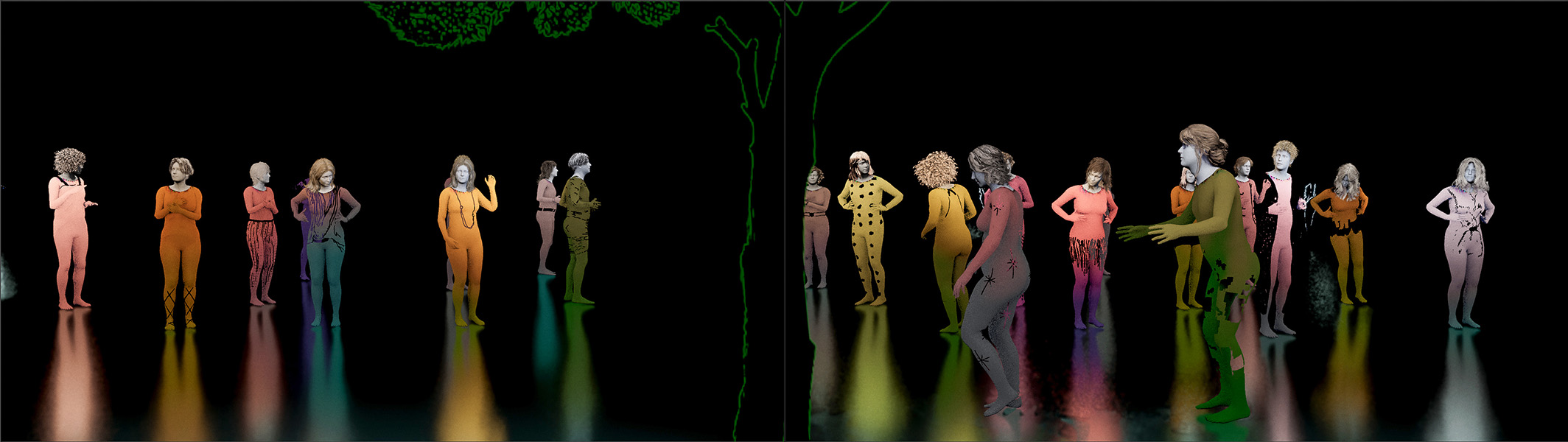
Ancestors, directed by Hanna Haaslahti, installed in the Tampere Art Museum in 2025. Photo: Jarkko Jortikka.
Success for Hanna Haaslahti’s Ancestors at Ars Electronica
Media artist Hanna Haaslahti’s immersive artwork Kaltaiset – Ancestors has been awarded an Honorary Mention in the New Animation Art category at the Prix Ars Electronica. The long-standing Ars Electronica Festival is held in Linz, Austria, from September 9 to 13, 2026. This year’s theme is Future Begins Negotiating with Humanity.
The Prix Ars Electronica jury describes Hanna Haaslahti’s work as hyper-immersive. In Ancestors, participants step in front of a camera and watch their digital doubles being born. The piece simultaneously brings together fellow humans in the physical exhibition space and their independent digital counterparts in a virtual world. As a third dimension, the viewer looks into a future where their digital descendants continue the family lineage. In the words of the jury:
“Ultimately, Haaslahti invites us to step beyond the regime of possessive individualism and learn to share our presence with others.”
Hanna Haaslahti has written and directed Ancestors. The immersive work has been realized by a multinational team assembled by her, including creative technologists and artists Tyler Henry, Alap Parikh, Mike Robbins, and Charu Tak.
Ancestors was built using the Unity game engine. Artificial intelligence is utilized for the real-time modeling of human faces, body animation, and the creation of virtual descendants. The goal of training the AI has been to allow viewers of all appearances to see themselves on the screen.
Hanna Haaslahti (b. 1969) is a media artist and a newly appointed artist professor living and working in Helsinki. Technological development has brought interesting perspectives and tools to Haaslahti’s work, where a strong interactivity with the viewer serves as one of the methods. Her works are often immaterial, cinematic projections in space, where the interaction of the participants creates communal experiences.
Ancestors had its national premiere in autumn 2025 at the Tampere Art Museum, where it aroused great interest. The exhibition attracted over 23,600 visitors.
The artists’ work, as well as the development and production of Ancestors have been supported by AVEK, the European Union, Film Tampere, the Kone Foundation, the Niilo Helander Foundation, and Yle, as well as partners Diversion, Digital Culture Centre MEET, High Road Stories, and Poike Productio.
The Ancestors project has been presented at international forums and markets, including Immersive Tech Week, Cinemart, IDFA, Nordisk Panorama, and the Immersive Market at Marcé du Film in Cannes.
Ancestors was produced by Fantomatico, with Tuuli Penttinen-Lampisuo as the producer.
FURTHER INFORMATION:
Prix Ars Electronica winners 2026 »
Read more about the Ancestors installation »
Hanna Haaslahti’s website »
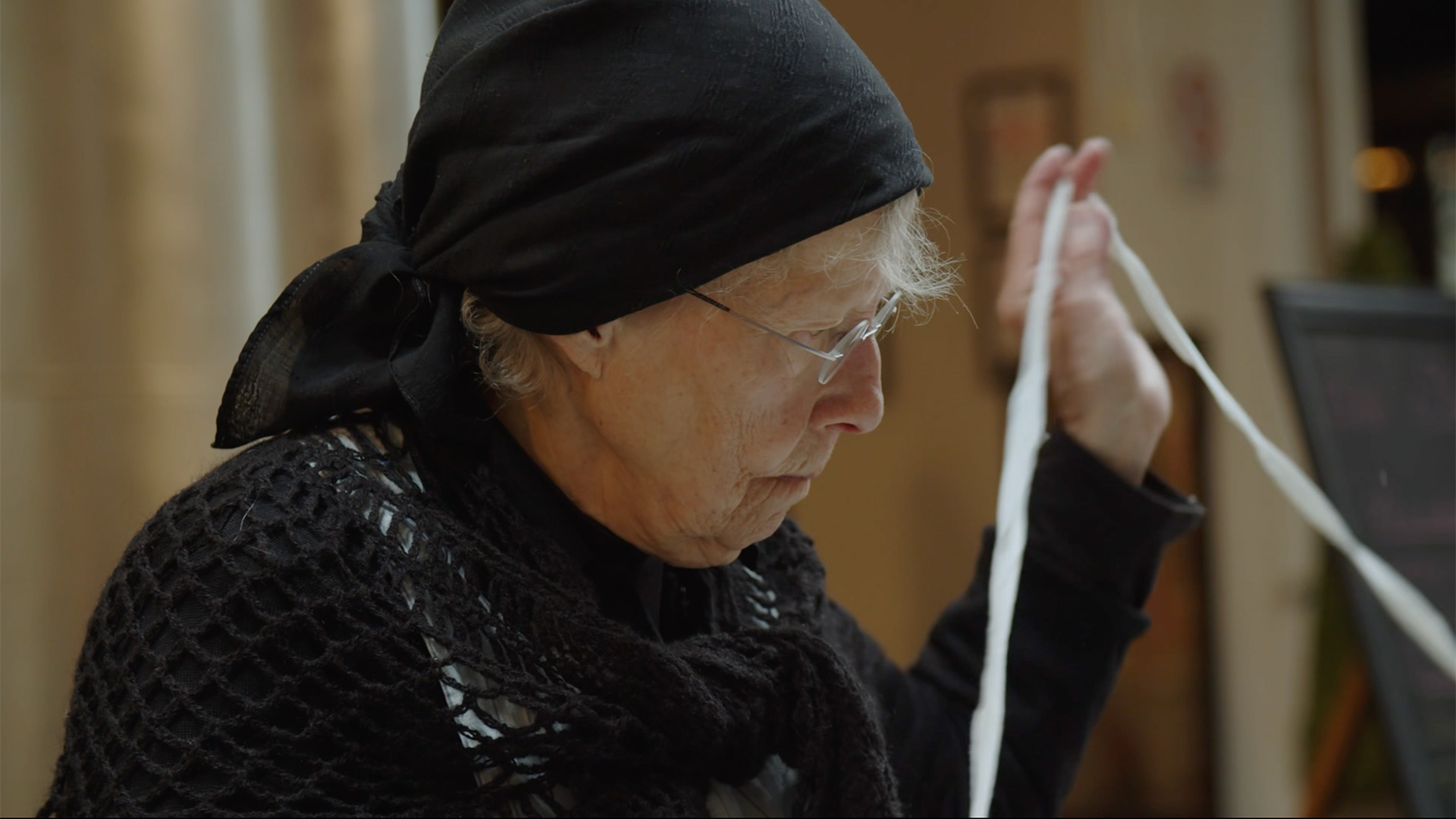
Performance artist Helinä Hukkataival in Martha’s Crochet, directed by Tuuli Penttinen-Lampisuo. Photo: Sami Sänpäkkilä.
Martha’s Crochet
Vikingagården Community Center, Jomala, Åland
13.8.–30.9.2026
A performance video, directed by Tuuli Penttinen-Lampisuo, presenting performance artist Helinä Hukkataival, is installed in the gallery of the Vikingagården Community Center in Jomala, Åland. The video is part of the exhibition Martha – Photographs and Videos by Helinä Hukkataival, curated by Mervi Appel.
Martha’s Crochet speaks to the beauty in the endless repetition of chores traditionally perceived as women’s work. Wearing a black dress, performance artist Helinä Hukkataival as Martha, refers to the biblical legend that questions whether a woman’s place is sitting and discussing, or serving others.
The short performance video was shot in the Finlayson Art Area in 2025. It is part of the artistic collaboration of Helinä Hukkataival, Tuuli Penttinen-Lampisuo and film editor Alison Taylor, who among others, currently work on a documentary film project about the performance art of Helinä Hukkataival.
The performance video, as well as the film project under process are supported by The Arts Promotion Centre Finland, The Finnish Cultural Foundation, the Kone Foundation and Ålands kulturdelegation.
Read more about Martha’s Crochet video »
Read more about the I AM YOU film »